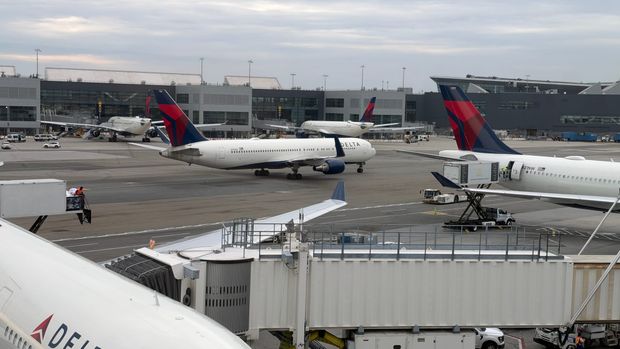
Delta's Starlink decision is starting to look like one of the airline's rare unforced errors. United, Alaska and Southwest are racing to install SpaceX's satellite Wi-Fi. Delta passed on it and is waiting for Amazon's alternative, which won't start appearing on its planes until 2028.
I've always given Delta credit for getting the details right. It runs one of the most reliable operations in the U.S., and it was among the first big American airlines to make Wi-Fi free for loyalty members. That's exactly why this decision frustrates me.
The Choice
Starlink, SpaceX's satellite internet service, uses satellites that orbit much closer to Earth than older systems do. In practice, that means faster speeds and less lag, which is why it's quickly become the standard other airlines are measured against. United has already installed it on more than 600 planes, about 36% of its fleet, and expects to finish in 2027.
Delta went another way. A deal signed in March will put Amazon Leo, Amazon's new satellite service, on 500 of its planes starting in 2028. Until then, it's relying on its existing providers, Viasat and Hughes.
According to Elon Musk, the sticking point was Delta's insistence on keeping its own login portal, which Starlink doesn't allow. CEO Ed Bastian reportedly told employees at internal events that Delta doesn't "want to be with Elon Musk," though those comments haven't been confirmed.
The Competition
Waiting until 2028 is a long time in a competitive business, and United has noticed. This week it launched a status match campaign aimed squarely at Delta's frequent flyers, pitching its faster Wi-Fi as a reason to switch.
Business travelers are Delta's most valuable customers, and they're exactly the people who work on planes. If a consultant flying from Atlanta to New York every week can count on smooth video calls on United but can't be sure of the same on Delta, that matters more than any lounge or seat upgrade.
Delta's Wi-Fi also still has gaps. According to the airline, it plans to bring complimentary access to its full global fleet by the end of 2026, which means some flights still go without it today.
Both @United and @AmericanAir have @Starlink! pic.twitter.com/7EfINWq1nU
— Elon Musk (@elonmusk) October 1, 2026
Delta's Argument
To be fair, Delta isn't starting from zero. Free Wi-Fi is already available on more than 1,000 of its planes, and speeds are fast on many of them. Amazon Leo could also turn out to be excellent, and keeping control of its own Wi-Fi experience lets Delta tie it closely to SkyMiles.
Passengers judge Wi-Fi on the flight they're actually on, though. For the next couple of years, more of those flights are likely to feel slower on Delta than on its biggest rival.
Next Steps
Doubling down makes this worse. This is an airline that built its reputation on not letting pride get in the way of the customer experience, and digging in over a login screen or a personal rivalry doesn't fit that story.
A smarter move would be a bridge: putting Starlink on the planes that matter most to business travelers now, then moving to Amazon Leo if it proves better. Airlines use different Wi-Fi providers across their fleets all the time, and Delta already does.
The airline has been right about a lot over the years. When it comes to Wi-Fi, the longer it waits, the more travelers it gives United a reason to try.