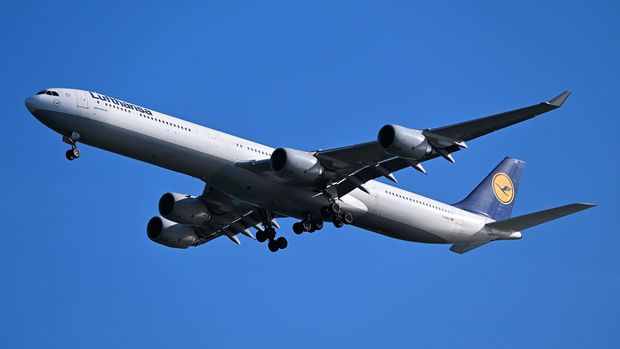
Just over a month from now, on October 25, the Airbus A340-600 makes its last scheduled passenger flight. That service leaves Riyadh for Frankfurt, and when it lands, one of the most distinctive aircraft of the past 25 years goes quiet for good.
Only one airline in the world still flies passengers on the type, and that's Lufthansa. The German carrier has been the most loyal operator the A340-600 ever had, running 24 of them at its peak out of the 97 Airbus ever built. A handful are left now, and most of those have already been parked.
Until then you can still catch one. Through October 24, Lufthansa is flying daily rotations from Frankfurt to New York JFK, Washington Dulles and Riyadh. That's 145 flights in the type's final month.
End of the line
The Last A340-600 in Passenger Service
Schedule data from Cirium. Lufthansa is the last airline flying the A340-600 in passenger service.
Contrail
Why Four Engines Lost
Quadjets built modern aviation. For decades, four engines meant range, and an airline wanting to cross an ocean needed them.
So why are they disappearing? It comes down to one word: money. Four engines cost more to run than two, and the gap isn't small. Today's twins pair highly efficient engines with less weight and less drag. Maintenance bills are far lower too, since there are half as many engines to inspect, service and eventually replace.
What changed is that twins caught up on the things quads used to own. Boeing's 787 and the Airbus A350 fly the distances that once required four engines, and they carry a comparable load of passengers. Lufthansa's A340-600 seats 281 people across four cabins, which is well within what a modern twin handles.
That leaves airlines with an aircraft that does the same job for more money. Flying a full A340-600 can cost more than flying a half-empty 787, and no amount of affection for a design survives that math for long.
What Made It Special
This variant stretched the A340 family into something genuinely unusual. When it entered service it was the longest airliner ever built, measuring 75.36 meters or 247 feet and 5 inches. Boeing's 747-8 and 777-9 have since passed it, but for years nothing else came close.
It first flew in 2001, with Virgin Atlantic as the launch customer, and Lufthansa introduced its own in 2003. Four Rolls-Royce Trent 556 engines push it to a cruising speed around Mach 0.83, and it can fly roughly 7,500 nautical miles, far enough to connect almost any two major cities in a single hop. Its wingspan measures 63.45 meters, and a fully loaded example weighs up to 368 tonnes at takeoff.
Inside, the cabin is a time capsule of early 2000s long-haul design. Lufthansa's version has eight first class suites in a 1-2-1 layout, business class in an angled 2-2-2 arrangement where window passengers climb over a neighbor to reach the aisle, premium economy at 2-3-2 and economy at 2-4-2. Some of the lavatories sit below the main deck, down a staircase, which almost no other airliner has done.

A Bittersweet Goodbye
Lufthansa isn't giving up on big old aircraft entirely. It still flies the world's largest passenger fleet of Boeing 747s, so the four-engine sound won't vanish from Frankfurt when the A340s go.
Even so, October 25 is a real ending. An aircraft that carried Lufthansa's flag across the Atlantic for two decades is being replaced by something quieter and cheaper. To a lot of people who love flying, it's also considerably less interesting to watch.
If you want one last ride, the Frankfurt routes to JFK, Dulles and Riyadh are the only places left to find one. There are just a few weeks to do it.