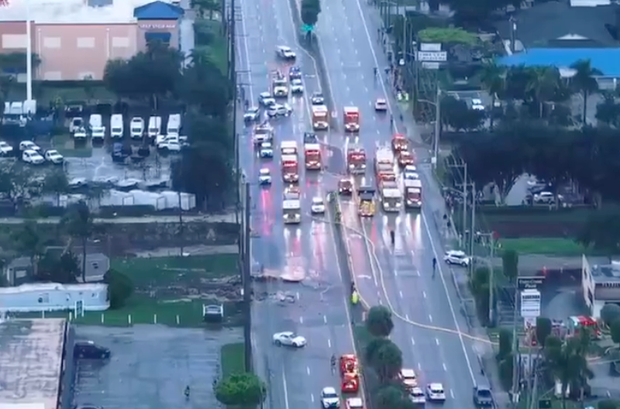
The Florida Learjet crash took a turn on Monday, when the NTSB said it has evidence the business jet began breaking apart before it hit the ground. All nine people on board were killed, including an Austin family with two young children, relatives have said. "We do have evidence that there was some breakup of the aircraft before impact," NTSB Member Tom Chapman told reporters. Investigators didn't say which part came off first.
My grandfather spent 25 years in New York air traffic control, rising from controller to deputy chief of New York Center, which handles high-altitude traffic over the region, and chief of the control tower at Republic Airport on Long Island. On Sunday he told me what controllers hear when a plane goes down. After Monday's briefing, I texted him again with a list of questions. His first answer came back within minutes: "Looks like structural failure to the tail section. Question is what caused it. Weather? Or defective design or construction."
That's his read, not the NTSB's, and investigators haven't confirmed which part failed. But here's how someone who spent a career watching planes on a radar screen is thinking about it.
Why He's Looking at the Tail
He pointed to a photo shared online that he says shows the tail already separated from the rest of the plane just before impact. We haven't been able to verify the photo, and the NTSB hasn't said anything about the tail specifically. But a reporter at Monday's briefing asked the same question, about the horizontal stabilizer, the small wing on the tail that keeps the nose steady, and that's when the NTSB said the plane broke up in the air.
How could weather do that? He said the conditions the crew described "create excessive loads on aerodynamic surfaces." In plain English, ice, turbulence and a plane suddenly diving at extreme speed can push the wings and tail far harder than they're built to handle. The crew reported ice and moderate turbulence at 35,000 feet minutes before the plane fell, and they reported an overspeed warning as it dropped.
What Investigators Need Next
"Investigators need tail," he wrote, and they'll examine it "for signs of over-stressed components," meaning metal that bent, stretched or snapped under more force than it was designed for. That's what separates the two possibilities he raised. Parts that failed under extreme force point toward what the plane went through in the air. A weakness in how something was built or maintained points somewhere else.
Finding the tail may take time. The NTSB said Monday that parts of the plane may have landed some distance from the main crash site, and asked anyone who finds debris not to touch it and to call the authorities.
Cause or Result?
When I followed up Monday night, he said this crash is “going to be hard to solve,” because there’s no way to measure how much energy a storm like that puts into a plane. “Most pilots are taught not to fly into thunderstorms,” he said, and either the pilot or the co-pilot could have been flying at the time.
He also raised a possibility investigators will have to rule out: that the tail breaking off wasn’t the cause at all. “Suppose the tail separating was not the cause but the result of improper maintenance on another system that caused the flight crew to react by overzealous control application?” That’s why he wants to hear the cockpit voice recording “from a few minutes before the loss of control,” if there is one, and see the plane’s maintenance records.
He came back to the ice as well. When ice builds up on a plane’s windows, he said, it’s likely forming on the wings too, and that’s the more dangerous kind. “Wing icing robs [the plane] of lift insidiously. It creeps up on you.” Planes have two defenses against it. De-icing removes ice that’s already there, while anti-icing keeps it from forming, at the cost of a little engine power.
Charters Play by Different Rules
The flight was a paid charter, operated by Aurora Jet, which means it ran under a different set of federal rules than the airline flights most of us take. My grandfather said airlines face stricter rules about flying into areas of known thunderstorm activity, and when I asked why charters don't, his answer was blunt: "Just a policy decision." Fewer people fly on charters, he said, so the rules have been written with fewer potential deaths in mind.
He also said controllers aren't always the ones watching the weather. In his experience, their radar screens don't show storms unless a crew asks about them. Modern radar displays can show weather, but a controller's main job is keeping planes apart, and much of the weather picture comes from what pilots report themselves. That's part of why the NTSB said it needs to figure out "who knew what when."
Would He Fly on One?
My last question was the simplest one. Would he fly on a charter jet like this?
"Not as a rule," he wrote. "Until I know for sure, if I do fly, I'll fly commercial."
The NTSB's preliminary report usually comes out within about a month, and a final cause can take a year or more. We'll keep following the investigation, and I'll keep asking him what he sees.