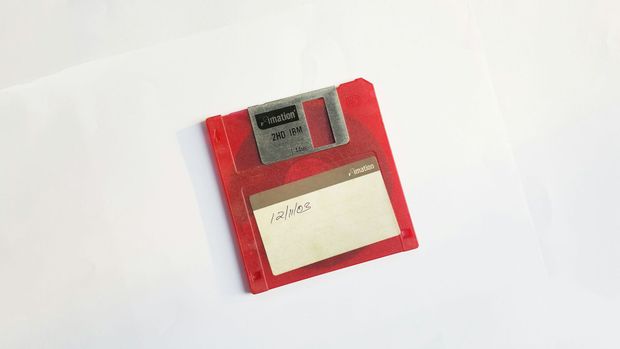
Does air traffic control still use floppy disks? Yes, and not as a museum piece. The FAA said on Thursday that floppy disks are still used to load weather and other critical information at more than 400 of its air traffic control facilities, and it plans to finally get rid of them by the end of 2028.
If the last time you touched a floppy disk was to save a school report in the '90s, you're not alone. They stopped being common more than 25 years ago and haven't been made in large numbers since 2011. Yet they're still part of the system that keeps roughly 45,000 flights a day apart over the US.
What the FAA Is Replacing
The floppy disks are going away as part of a new tool called the Enterprise Information Display System. It replaces four separate systems that date back to the 1980s and puts weather, runway and other operational information in one place, so controllers don't have to juggle different screens and disks to find it. FAA Administrator Bryan Bedford said the new setup will let controllers "instantly share critical flight alerts" instead of relying on manual steps.
That second part matters more than the disks themselves. Bedford described today's network as one where "every facility is a silo," with individual computers that can't easily talk to each other. The FAA is also still working off decades-old Compaq computers, with some replacement parts reportedly bought on eBay, and it's in the middle of phasing out the paper flight strips controllers have used for generations to track planes. Twenty-seven major airports have already switched to electronic strips since 2022, and the other 49 won't finish until at least 2028.
Why It Matters for Your Flight
None of this means your flight is unsafe. Controllers are trained to work around failures, and old technology that's well understood can be surprisingly reliable. The problem is what happens when it breaks. When systems can't share information and parts are hard to find, a single failure can ripple across a whole region, and the fix tends to be slowing everything down.
We've seen that play out this fall. In September, a circuit failure at a Philadelphia facility and a fiber cable cut by a construction crew in New Jersey led to ground stops at Newark, JFK and LaGuardia and delayed or canceled thousands of flights across the Northeast. In October, a cable cut outside a gate at Houston's Bush Intercontinental Airport knocked out FAA data and forced another ground stop. An FAA memo to airports last month pointed to those outages and asked airports to coordinate construction more carefully around the agency's cables.
Floppy disks didn't cause those outages, but they're a good symbol of the larger issue: a system built piece by piece over decades, with too few backups and too little connection between the pieces.
Will It Actually Get Done?
The money is the biggest question. Congress approved $12.5 billion last year to start fixing the air traffic control system, and Transportation Secretary Sean Duffy wants about $30 billion more. We've been following the push for that funding, including the bill that would put $30 billion toward new air traffic control, and it's still far from settled.
Our take: 2028 is a realistic target for the floppy disks, because swapping out a display system is a much smaller job than rebuilding radar or communications networks. The harder part is everything around it. The FAA is also short on people, with too few air traffic controllers to keep up with demand at several busy airports, and new technology doesn't help much if there's no one to run it. So expect the upgrade to be quiet when it works, and noticeable mainly on the days something else goes wrong.
What You Can Do
For travelers, the practical advice hasn't changed. When an outage or ground stop hits, the earliest flights of the day usually recover first, so booking early departures gives you the most room to rebook. Turn on alerts in your airline's app, and if you're connecting, leave yourself a little more time on days when weather or outages are already causing trouble. And if your flight does get canceled, here's what airlines owe you.