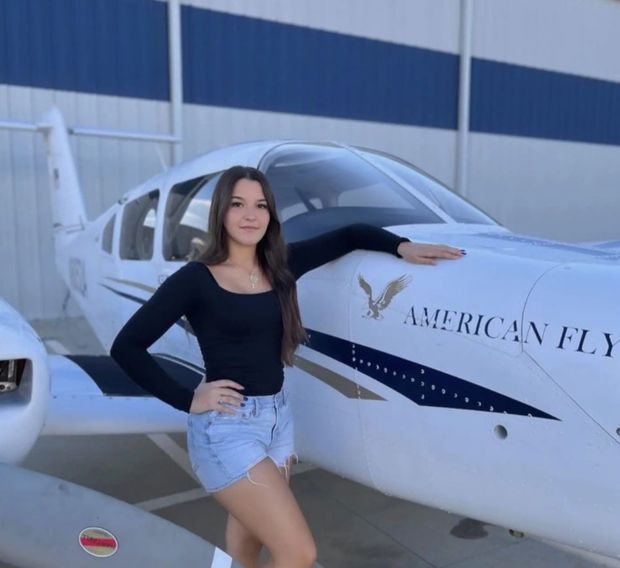
The father of Nathalia Gadelha Filgueiras, the 20-year-old co-pilot killed in last Sunday's Learjet crash in Florida, says he has listened to her final radio calls "many times." What he hears is a daughter who stayed calm until the end. "She's tough," Allan Filgueiras, himself a pilot, said at a news conference on Friday. Through tears, he said he wished he could have been with her in the cockpit "to help."
The family spoke out partly to push back against people online who questioned whether someone so young belonged in the cockpit of a business plane. Their attorney, Stuart Grossman, said they wanted to protect "not just her memory, but her reputation."
What Her Father Said
Allan Filgueiras took his daughter flying for the first time when she was 12, and he helped teach her to fly. After she landed her pilot job, he said, she couldn't believe someone was paying her to do the thing she loved most. On the radio recordings from Sunday, she first calmly reported ice building up on the plane as it flew into a thunderstorm. Minutes later, as the Learjet fell, she declared the emergency herself, reporting that the plane was in an overspeed condition and descending 20,000 feet per minute.
Nine people died when the plane came down in a Greenacres neighborhood in Palm Beach County: Filgueiras, the captain, Jeff Gregory, 55, and seven passengers, including an Austin family with two young children. Gregory is believed to have been flying the plane in its final minutes.
The Questions About Her Age
Within days of the crash, social media filled with comments asking whether a 20-year-old should have been flying a Learjet 60 at all. The family says those comments ignore her record. She had logged more than 1,300 flight hours, according to her family, and had completed the training for a commercial pilot certificate and a Learjet rating. Her attorney called her "perfectly qualified" and "the top of her class." One of her first flight instructors, Chris Kirk, has said an examiner at her check ride this spring assumed she had more than 5,000 hours.
We've seen it on our own accounts. Contrail's social media has received thousands of comments, especially on Instagram, from people saying she shouldn't have been flying. Honestly, I think it's insane that people are doing that. She was fully licensed and no more or less legal than any other pilot. People like to poke at any weakness they can see. We have this constant human urge to find an explanation for everything, and in the process we blame too quickly and inaccurately, and we hurt a lot of people along the way.
It's a hard thing for a family to have to do in the same week they lost their daughter. And it's worth separating two questions that often get mixed together online: whether she was qualified, and what caused the crash. Investigators haven't said anything that points to the co-pilot as a cause.
What It Takes to Fly in the Right Seat
Most travelers have never had a reason to know what the rules are for the second pilot on a charter plane, and they're different from the rules for airlines. To be a co-pilot on a charter flight like this one, the FAA requires a commercial pilot certificate with an instrument rating, which you can earn at 18 with as few as 250 hours of flight time, plus specific training on that type of plane. Some charter operators that use a special status with the FAA have to meet a higher bar of 500 hours for co-pilots.
Airlines are stricter. Since 2013, every co-pilot on a US airline has needed an airline transport pilot certificate, which generally takes 1,500 hours, or as few as 750 to 1,250 hours with a restricted version for pilots who come from the military or certain college programs. You have to be at least 21 to hold even the restricted version.
Put her numbers next to those rules and the picture is clearer than the comments suggest. With more than 1,300 hours, she had about five times the minimum to get her commercial certificate and well over double the 500-hour bar some charter operators use. She was also within a couple hundred hours of what a full airline co-pilot needs. Her age kept her out of an airline cockpit, not her experience.
What Investigators Are Looking At
The cause of the crash is still unknown. The National Transportation Safety Board has said the plane was breaking apart in the air, with pieces of its tail found more than a mile from where it hit the ground, and that the crew reported ice and heavy turbulence as they flew through strong thunderstorms. We've been following every update from the investigation, and the NTSB's preliminary report is usually due within about a month. A final report with an official cause can take a year or more.
Whatever it finds, the family's message on Friday was simple. Their daughter loved flying, worked hard to get where she was and did her job until the very last moment.