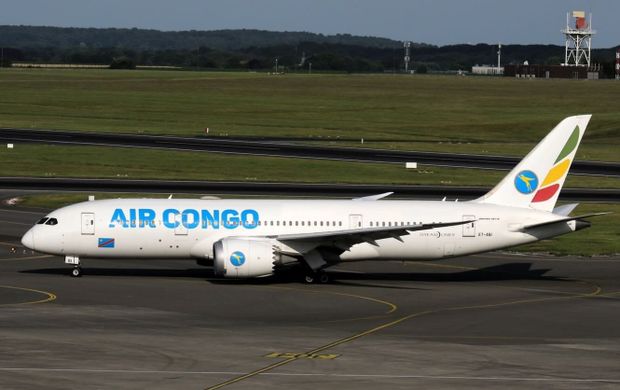
For many years, a strong national airline has been an ambition of the Democratic Republic of Congo and its people, and Air Congo is now turning that ambition into reality. The DRC is Africa's second-largest country, covering about 905,000 square miles, and its population of more than 100 million is spread widely across that territory. Some regions were extremely difficult or even impossible to reach any other way, so the country needed an airline that could transport its citizens and connect every part of the nation.
Air Congo was established by Ethiopian Airlines Group, Africa's largest airline group, in partnership with the DRC government. The government holds the majority stake at 51%, with Ethiopian owning the remaining 49%. This kind of national carrier ownership has become common for Ethiopian, which has similar agreements with other governments for their airlines. The airline was a long time coming for the government, which has laid out numerous plans for major and small airports across the country.

The Hope of Africa
Air Congo launched on December 1, 2024, carrying the hopes of a country that had waited a long time for it. It was created mainly to address two issues for the Congolese people: connectivity and affordability. Travel inside the country depended heavily on small charter aircraft, which limited the regions and distances a single flight could reach. Hiring an aircraft was also extremely expensive, so flying was accessible to only a small minority. Those flights had no schedules or consistency either, which made air travel even more difficult for ordinary people.
The airline's primary hub is N'djili International Airport in Kinshasa, where it's also headquartered. For international travel, passengers had depended mostly on foreign carriers such as Ethiopian Airlines, which serves both Kinshasa and Lubumbashi.
Another challenge was building a network that would improve on the one its predecessor had. Congo Airways, the former national carrier, never escaped the European Union's safety ban. That ban still bars every airline certified in the DRC from flying to Europe, and Congo Airways has also been grounded for much of 2026.
Timeline
Air Congo's First 19 Months
Congolese airlines remain banned from EU skies, so Ethiopian's plane and crew fly the Brussels route under the Air Congo name.
Contrail
The Starting Point
On December 1, 2024, the airline began scheduled service with two Boeing 737-800s leased from Ethiopian Airlines. It flew domestic routes from seven airports, including Kinshasa, Lubumbashi, Goma and Kisangani. On December 17, President Félix Tshisekedi officially inaugurated the airline in Kinshasa. Still with two aircraft and a domestic-only network, the airline didn't worry its competitors or catch anyone's eye as a main player in African aviation. Through 2025, the carrier stayed quiet as it focused on its domestic routes, and by its first anniversary it was serving seven domestic cities, with the government saying its planes were flying 80% to 100% full.

The Growth
In February 2026, the expansion started. The airline announced its first international routes, and on March 22 it flew to Johannesburg by way of Lubumbashi and to Entebbe in Uganda. The Johannesburg route now operates three times a week, on Wednesdays, Fridays and Sundays. Within a week, Air Congo added Cotonou in Benin and Douala in Cameroon. By May, a third Boeing 737-800 had joined the fleet.
Next, the airline brought the ATR 72-600 into service on domestic routes, a turboprop built for shorter regional hops. Its second ATR arrived in May 2026, bringing the fleet to five aircraft.
Then came an agreement for Ethiopian to provide Air Congo with a Boeing 787 Dreamliner through a wet lease, in which Ethiopian supplies the plane along with its crew, maintenance and insurance. With this new agreement and the ambition the airline was showing, the question that followed was which route was next on its list.
The answer was Europe. On July 1, 2026, a Congolese airline flew to Europe for the first time in 18 years with nonstop flights between Kinshasa and Brussels. The last one to do so was Hewa Bora Airways, before the EU banned it in 2008. This was huge! The new route officially put Air Congo on the map. Because DRC airlines remain banned from EU skies, Ethiopian's 787 and crew operate the flights under the Air Congo name. Air Congo became a real competitor on the route, ending Brussels Airlines' long-held monopoly on nonstop flights between the two cities.
Conclusion
In less than two years, Air Congo has gone from two leased planes to a network that stretches across Africa and into Europe. The airline's leadership has already talked about flights to Paris and Dubai, and if it keeps growing at this pace, it may truly become the hope of Africa.